
Your Dashboard Is Answering the Wrong Question
Most executive dashboards answer one question well.

What happened?
Revenue last quarter, headcount changes, pipeline coverage. That is useful. But it is also the easy part and for most high-stakes decisions, it is not what executives actually need.
The question that matters is different.
What should we be paying attention to before the decision gets made for us?
That is the shift Chapter 6 of Smart Dashboards with Power BI, ChatGPT, and Copilot is built around. We use M&A as the example because acquisitions show the gap between reporting and decision support more clearly than almost anything else.
Where the gap shows up
Imagine a company evaluating a major deal.
A normal dashboard shows the things you would expect. Revenue trends. Stock price movement. Deal timeline. Comparable transactions. All relevant.
But the signals that actually move the needle on whether a deal closes and on what terms, are usually scattered.
Analyst commentary is shifting tone, even while the stock holds steady. Investor sentiment looks strong, but regulators are asking tough questions. The closing timeline is starting to slip, while the headline narrative still looks fine.
A basic dashboard shows each of those in a separate tile.
A smarter dashboard connects them. It helps the team see whether confidence is improving, whether risk is building, and what deserves attention before the next board meeting.
That is the difference between reporting and decision support. Reporting tells you what happened. Decision support tells you what is changing, and why it might matter.
The most useful thing ChatGPT does and it is probably not what you think
This is where most “AI in BI” content gets it wrong.
The temptation is to ask ChatGPT to build the dashboard. That does not work well. ChatGPT does not know your decision, your audience, your risk tolerance, or your politics. You get generic output.
The real leverage is upstream. Before any visual gets built.
For the M&A dashboard in Chapter 6, that means using ChatGPT to pressure-test the decision logic first.
What is a leading indicator versus a lagging one? What turns normal deal noise into a real warning sign? What does an executive need to grasp in 30 seconds? What should trigger a deeper review, not just a notice?
ChatGPT is good at organizing that thinking. It can take a vague request like “we need a dashboard for the deal team” and turn it into something specific enough to actually build.
It will not replace business judgment. The team still has to bring that. But it gets you from blank page to working framework much faster.
This is the two-layer workflow the chapter walks through. ChatGPT for strategic design. Copilot for execution inside Power BI.
Where Copilot fits
Once the decision logic is clear, Copilot earns its keep.
It suggests visuals. Drafts DAX measures. Builds Q&A experiences. Summarizes model output in plain language — for example, “Sentiment declined 12% following FTC inquiry update” without requiring an analyst to write the prompt from scratch.
What Copilot does not do is rescue a weak data model or invent the framing. If nobody knows what the dashboard is supposed to help people decide, more charts will not fix that.
The chapter pairs the two tools deliberately. ChatGPT helps you decide what to build. Copilot helps you build it faster.
The point of the M&A market sentiment and predictive analytics dashboard
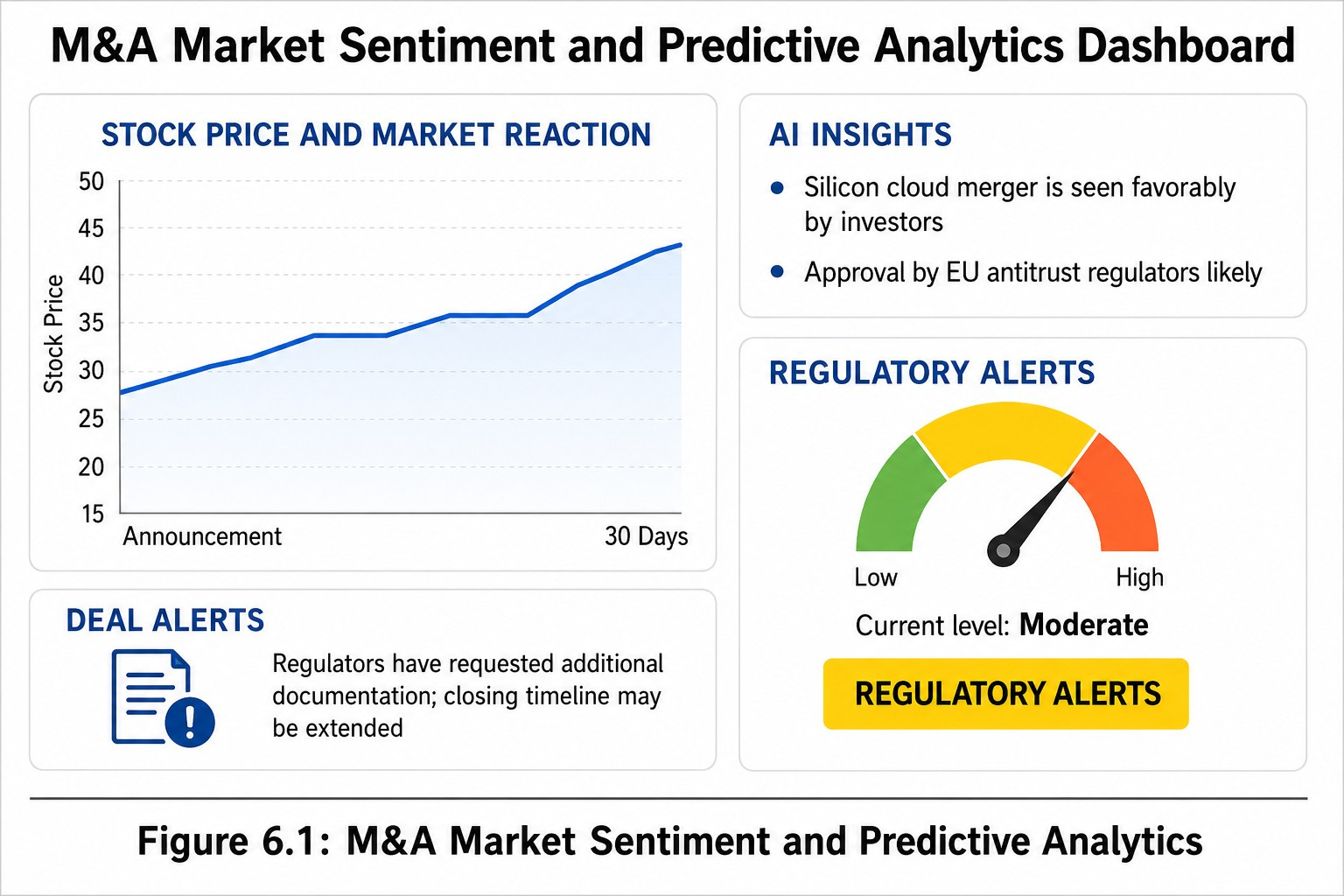
The dashboard from Chapter 6 shows a simple version of an M&A market sentiment and predictive analytics dashboard. Stock price reaction. AI-generated insights. Regulatory alerts. Deal alerts.
It is not the full system. It is the smallest version that demonstrates the principle.
And the principle is this.
Predictive analytics in a business dashboard should not pretend to forecast the future with perfect accuracy. It should not bury the page in machine learning output. And it should not add complexity.
It should help the business notice important changes earlier.
In M&A, that means catching rising regulatory risk before it becomes the lead story in the deal. It means seeing market sentiment improve faster than expected and adjusting communication timing accordingly. It means flagging a slipping close date while the headline numbers still look fine.
That gives leadership time to ask better questions before the decision is already made for them.
The bigger point
The best dashboards are not collections of charts. They are decision tools.
ChatGPT helps think through the decision. Copilot helps speed up the build. Power BI brings it together.
The goal is not prettier charts.
The goal is better decisions.
Chapter 6 walks through the full M&A example plus two more examples, chip manufacturing and agriculture using the same two-layer workflow.
Smart Dashboards with Power BI, ChatGPT, and Copilot is available now on Amazon.